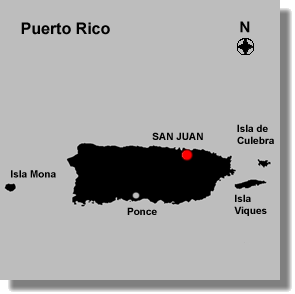
|
General
Country: Puerto Rico (RQ).
Nationality: Puerto Rican(s).
Languages: Spanish, English.
Capital: San Juan.
Population: 3,966,213 (July 2010 est.).
Population growth rate: 0.298% (2010 est.).
Climate: Tropical marine, mild; little seasonal temperature variation.
Hurricanes frequently occur between August and October, although less than
Jamaica, Cuba, and the Lesser Antilles.
Geography
Area: Total: 13,790 sq km, land: 8,870 sq km, water: 4,921 sq
km.
Coastline: 501 km.
Geographic coordinates: 18 15 N, 66 30 W.
Highest point: Cerro de Punta 1,339 m.
Location: Caribbean, island between the Caribbean Sea and the
North Atlantic Ocean, east of the Dominican Republic.
Size: 180 km from East to West and a 65 km wide.
Terrain: Mostly mountains with coastal plain belt in north; mountains
precipitous to sea on west coast; sandy beaches along most coastal areas.
Tourist Information
Accommodations: Puerto Rico offers a huge variety of lodgings.
Activities: Scuba diving, surfing, bird watching, horse back
riding, golf, fishing, hiking. Casinos are located in many of the large
hotels around the island. We recommend sightseeing in Old San Juan and
a tour to the El Yunque National Forest.
Average tourist arrivals: 1,300,783 (2009).
Crime: Puerto Rico has a crime problem, as of 2002 the island's
murder rate was twice that of New York City! Most crime is either passional
or drug-related. Violence does not extend into ordinary life. Visitors
should observe the same precautionary measures that would apply anywhere
else.
Electricity: 120 Volts, 60 cycles. Only flat blade plugs are
used.
Entry Requirements: There are no passports or visas necessary
for United States citizens, they only need to have some form of official
government issued picture identification such as a current driver's license.
Citizens of other countries have the same requirements as for entering
the USA.
Extension of stay: Possible. You must apply for an extension
of stay before your previous stay has expired.
Telephone: Country code - 1-787.
Time: Atlantic Standard Time (EST +1; GMT -4) all year around.
Tourism Office: La Princesa Bldg., #2 Paseo La Princesa, Old
San Juan, P.R. 00902.
Money
Cost of living: Cheaper than in the United States, except for
in San Juan where it is expensive.
Credit cards: Widely accepted for accommodations, dining and
shopping.
Currency: US Dollar.
Tipping: Tipping is expected, usually 15 % in restaurants, 10
% in bars, and 10 - 15 % for taxi drivers, hairdressers, and other services,
depending on the quality of the service rendered. Tip a porter, either
at the airport or at your hotel, $1 per bag.
Transport
Airport: Luis Muñoz Marin International Airport (SJU)
is located 14km (9 miles) east of San Juan. Regular buses and airport shuttles
run to San Juan, where there is a ferry service from Pier 2 across the
bay to Catano. There is a ground transportation information desk at the
airport, which gives information and books tickets for all types of travel.
Baldorioty de Castro Avenue runs west from the airport past the Isla Verde,
Ocean Park and Condado sectors (tourist areas) into Old San Juan.
Departure Tax: 5 USD, usually included.
Flight Times: New York 3 ½ hours, Los Angeles
8 hours. Miami 2 ½ hours, Europe 8 - 12 hours.
Ground Transportation: Cars and mini-buses provide low-cost public
transportation around the island, but w.e suggest to rent a car.
Ferry Service: Ferries del Caribe (www.ferriesdelcaribe.com)
offer ferries three times a week between Santo Domingo in the Dominican
Republic, and Mayagüez in Puerto Rico. On the eastern end of Puerto
Rico, the town of Fajardo runs ferries to both Culebra and Vieques.
Ports and harbors: Guayanilla, Mayaguez, San Juan.
Politics
Ethnic groups: White (mostly Spanish origin) 76.2 %, black 6.9
%, Asian 0.3 %, Amerindian 0.2 %, mixed 4.4 %, other 12 % (2007).
Government type: Commonwealth.
Legal system: Based on Spanish civil code and within the US Federal
system of justice.
Literacy: 94.1 %.
Religions: Roman Catholic 85 %, Protestant and other 15 %.
Economy
Agriculture-products: Sugarcane, coffee, pineapples, plantains,
bananas; livestock products, chickens.
GDP per capita: $17,100 (2009 est.).
Industries: Pharmaceuticals, electronics, apparel, food products,
tourism.
Natural resources: Some copper and nickel; potential for onshore
and offshore oil.
Unemployment rate: 12 % (2002). |