Asa Wright Centre
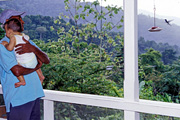
Asa Wright Centre
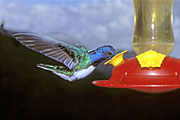
Hummingbird Feeding
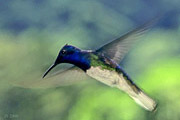
Hummingbird
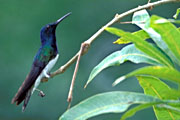
Hummingbird
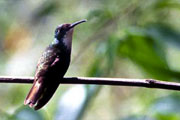
Copper Rumped Hb
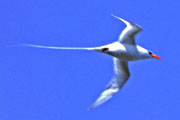
Red-Billed Tropicbird
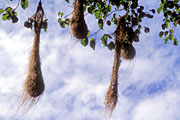
Bird Nests
|
There is plenty on Trinidad to occupy a full week of bird watching every
day. Trinidad is home to some of the most diverse and spectacular bird
life in the Caribbean. This variety can be attributed to the island's location
on the tip of South America. Recent studies suggest the possibility that
Trinidad separated from the South American Mainland as recently as 1,500
years ago!
Trinidad and Tobago has more than 450 officially recorded birds. Some
highlights include Oropendolas, Pepershrikes, Woodcreepers, Antbirds, Scarlet
Ibis, Red-Breasted Blackbirds, Turquoise Tanagers, Ruby Topaz, White-necked
Jacobins, and Red-legged Honeycreepers.
Many species can be seen without long drives or treks. Most famous places
for bird watching are the Asa Wright Nature Centre and the Caroni Swamp.
Asa Wright Nature Centre
The Asa Wright Nature Centre is located on the Spring Hill Estate,
1200 feet above sea level, in the middle of the Northern Range hills that
rise to 3,000 feet and run across the top of Trinidad. The drive from Chateau
Guillaumme takes about 30 minutes.
A twisty country road north of Arima takes you up the Northern Range,
the scenery is increasingly beautiful. The road passes a christophene farm
- a popular local vegetable known as Chayote squash in some countries.
Many acres of land are covered in net, six feet or so above the ground.
The crop hangs from the nets, making for easier harvesting. The fact that
the farm is surrounded by clusters of Hindu prayer flags makes the
place even more intriguing to us visitors from northern climes.
The Spring Hill Estate was originally a cocoa, coffee and citrus plantation.
The plantation fell into neglect and shortly after World War II was bought
by an Englishman, Newcombe Wright, and his Icelandic wife, Asa. They were
keen amateur ornithologists and became close friends of American explorer
and naturalist William Beebe, who purchased the adjacent plantation. The
Wrights played host to the many naturalist and birdwatchers who visited
the research station.
After Wright’s death, American wildlife artist, Don Eckelberry,
and conservationist, Emma Fisk, led efforts to buy the 200-acre estate
and convert it into a community-outreach centre. Asa agreed, on condition
that the estate remained a conservation area in perpetuity. A non-profit
trust under local and international management was set up in 1967. The
Asa Wright Nature Centre was born.
The aim of the trust is to protect the Arima valley and to create a
conservation and study area. A substantial part of the trust's income is
set aside for land acquisition. The Centre now owns some 2,000 acres of
land in the Arima and adjacent Aripo valleys. Over 150 species of bird
have been recorded at the Asa Wright, some are: White-necked Jacobin, Collared
Trogon, Blue-crowned Motmot, Chestnut Woodpecker, Great Antshrike, Bearded
Bellbird and Oilbirds.
Caroni Bird Sanctuary
Take a boat ride along the blue river into the mangroves of the Caroni
Swamp, and then into open water with mangrove clad islets to see the spectacular
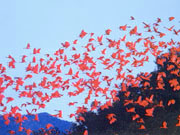
dusk arrival of about 2,000 Scarlet Ibis and herons returning from feeding
grounds in Venezuela.
Other birds, that can be seen here, are: Grey Potoo, Straight-billed
Woodcreeper, Black-crested Antshrike or Bicoloured Conebill.
Other good places for bird watching are:
-
The Northern Range (Double-toothed Kite, Channel-billed
Toucan, Black-tailed Tityra , Ornate Hawk Eagle, Golden headed Manakin,
Blue-headed Parrot, Rufous-tailed Jacamar, Slaty-capped Flycatcher, Red-legged
Honeycreeper, Speckled and Hepatic Tanagers)
-
Heights of Aripo (White Hawk, Common Black
Hawk, Violaceous and White-tailed Trogons, Purple Honeycreepers, Turquoise
and Speckled Tanagers)
-
Mount St Benedict (Long-billed Starthroat,
Green Hermit, Tufted Coquette, Copper-rumped Hummingbird, White-chested
Emerald and Ruby-topaz Hummingbird, Turkey Vultures, Ornate Hawk-Eagle,
Common Black Hawk, White Hawk, Short-tailed Hawk, Grey-headed Kite, Double-tooth
Kite, Rufous-breasted Hermit, Violaceous and White-tailed Trogons, Buff-throated
Woodcreeper, White-flanked Antwren, Golden-headed and White-bearded Manakins,
Rufous-breasted Wren, Long-billed Gnatwren, Tropical Parula, Southern Beardless
Tyrannulet, Rufous-browed Peppershrike, Blue Dacnis, Trinidad Euphonias
and White-shouldered Tanagers, Little Tinamou, Orange-winged Parrot, Saltators,
Scaled Pigeon, Pauraque, Tropical Screech-Owl, Ferruginous Pygmy Owl, Yellow
Oriole and Lesser Swallow-tail Swift)
-
Cumaca Valley mountains (Bellbirds, Woodpeckers,
Zone-tailed Hawk, Blue Dacni, Collard Trogon, Green Kingfisher, toucans,
White-flanked Antwren and many other desirable species)
-
Toco (Trinidad Piping Guan)
-
Valencia Stretch (Masked Yellowthroat, Stripped
Cuckoo, Plain Breasted Spinetail, Greyish Saltators and Peregrine Falcons)
-
Aripo Agricultural Research Station (Savannah
Hawk, Wattled Jacanas, Green-rumped Parrotlet, Yellow-chinned Spinetail,
White-headed Marsh, Pied Water Tyrants, Grey Kingbird, White-winged Swallow,
Red-breasted Blackbird, Southern Lapwing, Stilt Sandpipers, Cocoi Heron,
Striped Cuckoo and Pinnated Bittern)
-
Arena Dam (Grey Hawk, Plumbeous Kite, White-bellied
Antbird, Squirrel Cuckoo, Marsh and Water Tyrants, Osprey, Neotropic Cormorant,
Tree Duck, Yellow-Rumped Cacique and Rufous-tailed Jacamar)
-
Tricity Water Treatment Plant (Least Grebe,
Little Blue and Striated Herons, Snowy Egret, Yellow hooded Blackbirds,
Shiny Cowbirds, Yellow Oriole and wintering and migrating American shorebirds,
Lesser and Greater Yellowlegs, Spotted Sandpiper, Black-necked Stilts,
Ringed Kingfisher and Masked Duck)
-
Wallerfied Airfield (Pale-vented Pigeon, Fork-tailed
Palm Swift, Sulphury and Bran-coloured Flycatchers, Masked Yellowthroat,
White-tailed Goldenthroat, Moriche Oriole and occasionally Crimson-crested
Woodpecker. It is good for night birds: Pauraque, White-tailed Nightjar,
Nacunda Nighthawk, Tropical Screech Owl and Barn Owl)
-
Trinidad's West Coast (Limpkin and Long-winged
Harrier, Neotropic Cormorant, Brown Pelican, Tricoloured Heron, Little
Blue and Great Blue Heron, Striated Heron, Yellow-crowned Night Heron,
Snowy and Great White Egret, Semipalmated Plover, both Yellowlegs, Solitary,
Spotted, Semipalmated and Western Sandpipers, Laughing Gulls, Large-billed
and Yellow-billed Terns and American Black Skimmers)
-
Pointe-a-Pierre Wildfowl Trust (Scarlet Ibis,
Whistling Ducks, Saffron Finch, Red-capped Cardinal, Streak-headed Woodcreeper,
Grey-necked Wood Rail, Anhinga, Black-crowned Night Heron, Osprey and Ringed
Kingfisher)
- Trinidad's East Coast (Frigatebirds, Brown
Pelicans, Common Black Hawk, Yellow-headed Caracara, Bat Falcon, Red-rumped
Woodpecker, Black-crested Antshrike, American Pygmy Kingfisher, Silvered
Antbird, Striated Heron, American Purple Gallinule, Red-breasted and Yellow-hooded
Blackbirds, Shiny and Giant Cowbirds, Pinnated Bittern, Long-winged Harrier
and Azure Gallinule).
 |
ite-necked Jacobin
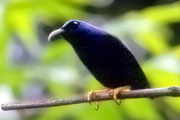
Purple Honeycreeper
Asa Wright Center
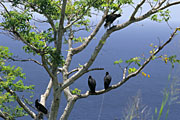
Black Bird
Sugar Lover
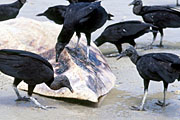
Turkey Vultures
Turkey Vultures
Scarlet Ibisses
|